

APIA Every Day is our commitment to learning and sharing about historic places significant to Asian & Pacific Islander Americans, every day.
Follow Us →

Day 331: Gila River War Relocation Center, Arizona
📌 APIA Every Day (331) - The Gila River War Relocation Center was located on the Gila River Indian Reservation in south-central Arizona, approximately 30 miles southeast of Phoenix. The center was divided into two separate camps—Canal and Butte—spread across the flat desert terrain of the reservation near the towns of Sacaton and Chandler. Situated within the lands of the Akimel O'odham (Pima) and Pee-Posh (Maricopa) peoples, the camp was one of ten incarceration sites used during World War II to forcibly confine Japanese Americans removed from the West Coast. The location’s remoteness, extreme heat, and limited natural resources made life difficult for the incarcerated individuals, while also imposing additional burdens on the tribal communities whose lands were used without their consent.
The Gila River War Relocation Center opened in July 1942 and operated until November 1945. At its peak, it held over 13,000 Japanese American men, women, and children, making it one of the largest of the incarceration camps. The residents were housed in hastily built barracks and subjected to military-style surveillance, surrounded by barbed wire and guarded by watchtowers. Despite the harsh conditions, those incarcerated at Gila River established schools, newspapers, places of worship, and even sports leagues, demonstrating resilience and a strong sense of community. Notably, some of the young men imprisoned there volunteered for military service, including the famed 442nd Regimental Combat Team, one of the most decorated units in U.S. history. The incarceration left a lasting impact on the Japanese American community and the Gila River Indian Community, whose land was used without proper restitution.
Preservation efforts at the Gila River War Relocation Center have been ongoing, though challenging due to the remote location and limited remaining structures. Much of the original site has returned to desert or agricultural use, and access to the land is restricted, as it is still part of the Gila River Indian Community. However, the Japanese American community and members of the Gila River Indian Community have worked together to ensure that the memory of the incarceration is not lost. Memorials have been established near the site, and historical markers provide context for visitors. Organizations such as the Japanese American Citizens League and the Gila River Indian Community collaborate to support educational initiatives, host remembrance events, and advocate for greater recognition of the site’s historical significance. These efforts are part of a broader movement to acknowledge injustices committed during World War II and to honor the resilience of those who endured them.

Day 330: Chinatown, San Diego, California
📌 APIA Every Day (330) - San Diego’s historic Chinatown was located in what is now the Gaslamp Quarter and parts of the Marina District, centered around Third Avenue between Market and Island Streets. This area, which once served as the heart of the Chinese American community in San Diego, was modest in size compared to other major Chinatowns but held great cultural and historical significance. The neighborhood was conveniently situated near the waterfront and the Santa Fe Depot, which allowed residents easy access to both economic opportunities and incoming goods. Though San Diego’s Chinatown never developed into a large enclave, it functioned as a vital center of cultural and social life for Chinese immigrants, including boarding houses, restaurants, laundries, and community organizations that helped maintain cultural traditions and provide support for newcomers.
The history of San Diego’s Chinatown dates back to the late 19th century, when Chinese immigrants arrived in the region seeking work on railroads, in fishing, agriculture, and later, service industries. By the 1880s, a small but close-knit Chinese community had formed in the downtown area. However, like other Chinatowns across the U.S., San Diego’s Chinatown faced significant racial discrimination, restrictive immigration laws like the Chinese Exclusion Act of 1882, and periodic hostility from the broader public. Despite these challenges, the community endured for decades, carving out a space that blended Chinese traditions with American urban life. Over time, demographic shifts, redevelopment, and the decline of the Chinese population in the area led to the dispersal of the original community, leaving behind only fragments of what was once a vibrant cultural district.
In recent years, a renewed effort has been to preserve the legacy of San Diego’s historic Chinatown through the creation of the Asian Pacific Historic District. Organizations such as the Chinese Historical Museum, located in the restored Mission Building at Third Avenue and J Street, serve as important cultural anchors and educational resources. Preservationists and community advocates have worked to document oral histories, restore historic buildings, and install interpretive signage to educate the public about the neighborhood’s past. While many of the original structures have been replaced or repurposed, the ongoing efforts to commemorate Chinatown’s history aim to ensure that the contributions of San Diego’s Chinese American community are not forgotten in the face of urban change.

Day 329: Japanese American Student Relocation Council, University of Connecticut, Storrs, Connecticut
📌 APIA Every Day (329) - During World War II, following the issuance of Executive Order 9066 in 1942, approximately 120,000 Japanese Americans were forcibly relocated to incarceration camps. Amid this injustice, the University of Connecticut (UConn), in collaboration with the National Japanese American Student Relocation Council, opened its doors to eighteen Japanese American students from these camps, providing them with an opportunity to continue their education despite widespread exclusion elsewhere.
The National Japanese American Student Relocation Council was formed in 1942 to help Japanese American college students continue their education after they were forcibly removed from the West Coast and incarcerated. Many Nisei students were suddenly cut off from their schools and futures. The Council, organized by the American Friends Service Committee with support from government and religious organizations, aimed to relocate these students to colleges and universities outside the restricted military zones, mostly in the Midwest and East Coast. The goal was to preserve educational opportunities for young Japanese Americans and to show that they could be trusted and integrated into broader American society despite wartime suspicion and prejudice. The university’s decision to accept the eighteen students reflected a combination of humanitarian values, a belief in civil liberties, and a desire to support American citizens during a time of widespread racial prejudice and wartime fear. By offering a safe place to continue their education, UConn played a role in resisting the discriminatory policies of the era and affirming the rights of Japanese American students.
UConn continues to honor and preserve its historical connections to Japanese American experiences. The Asian and Asian American Studies Institute at UConn maintains a Japanese American Internment Resource Library, offering a wide array of materials, including videos, books, teaching aids, oral histories, and visual documentation to educate the public about this significant period. Additionally, in 2025, the William Benton Museum of Art hosted an exhibition titled "Minnie Negoro: From Heart Mountain to UConn," curated by professors Jason Chang and Hana Maruyama. This exhibition celebrated the life and work of Minnie Negoro, a Japanese American ceramic artist and former UConn professor who had been incarcerated during the war.

Day 328: Indochinese Cultural and Service Center (International Refugee Center of Oregon), Portland, Oregon
📌APIA Every Day (328) - The Indochinese Cultural and Service Center (ICSC) was founded in 1976 by Southeast Asian refugees fleeing political unrest in Vietnam, Laos, and Cambodia. Following the Fall of Saigon in 1975, Washington and Oregon were among the first U.S. states to resettle refugees, leading to the organization's emergence in Portland. At its establishment, the ICSC supported immigrants by helping them find employment and adjust to life in the U.S. through various social programs.
In the mid-1970s, local welfare agencies in Portland were overwhelmed by the influx of Asian refugees seeking aid. In response, a group of Vietnamese, Lao, Hmong, and Cambodian immigrants founded the ICSC to offer multilingual assistance to the city’s growing Southeast Asian community. At its establishment, the ICSC was located in the historic Neighborhood House in Lair Hill. This building was originally constructed in 1910 by the National Council of Jewish Women to aid Eastern European immigrants. Continuing this legacy decades later, the ICSC helped newcomers navigate American society and search for jobs.
In 1980, the Southeast Asian Refugee Federation (SEARF) was incorporated, providing immigrants with entrepreneurial training and interpretation services. Eventually, ICSC and SEARF partnered to become the International Refugee Center of Oregon (IRCO). By the 1980s, a new wave of refugees from countries including Afghanistan, Ethiopia, Eritrea, and Iran were arriving in the U.S. IRCO then expanded its focus beyond Southeast Asia, extending services to immigrants from Asia, Africa, the Pacific Islands, and Eastern Europe.
With this expansion, IRCO broadened its social services, adding employment training and translation assistance, among other resources. In the 1990s, the organization moved from the Neighborhood House to its current location on NE Glisan Street. Soon after in 1994, IRCO’s Pacific Islander and Asian Family Center was founded to offer a range of culturally specific services. In 2024, the Pacific Islander and Asian Family Center celebrated its 30th anniversary with the unveiling of a new mural celebrating the local Vietnamese, Cambodian, and Samoan communities among others.
In 1979 the original location of the ICSC, the Neighborhood House, was added to the National Register of Historic Places. Today, IRCO continues to carry the ICSC’s legacy forward, providing support to Portland’s diverse immigrant population for nearly 50 years. The Pacific Islander and Asian Family Center alone has served over 12,000 individuals in the past three decades.

Day 327: Yuba City Gurdwara, Yuba City, California
📌APIA Every Day (327) - The Yuba City Gurdwara, formally opened in 1970, was the first Sikh temple in the U.S. to be built in a traditional Indo-Persian architectural style. Located in Yuba City, a region known for its large Punjabi American population, the temple has served as a haven for the local Sikh community for over 50 years. Continuing today, the gurdwara provides a central community space for congregation members to worship and preserve their cultural traditions.
While Punjabi Sikhs had been settling in the Yuba-Sutter area since the early 20th century, the passage of the Immigration and Nationality Act of 1965 led to a surge in South Asian families moving to California. As the Sikh community grew, a nonprofit Gurdwara committee was formed in the late 1960s with 26 founding members, including influential community leaders Didar Singh Bains and brothers Bakhtawar and Udham Purewal. The Purewals donated three acres of farmland on Tierra Buena Road for the temple's construction. In 1969, a groundbreaking ceremony was held to commemorate the 500th birth anniversary of Guru Nanak, Sikhism’s founder.
The gurdwara opened the following year, featuring a spacious worship hall and a langar hall to serve meals to the community. Prior to its establishment, congregation members would have to travel over 90 miles to the Stockton Gurdwara (APIA Every Day 89) to practice their religion. As the local congregation continued to grow, it eventually led to the inauguration of the annual Yuba City Sikh Parade or Nagar Kirtan in 1980. Didar Singh Bains was inspired to start the yearly tradition when he previously attended a similar event in Canada. The three-day weekend festival typically concludes on Sunday with a procession of floats moving through the city starting their route at the Yuba City Gurdwara.
Today, the Yuba City Gurdwara continues to serve as a significant religious and cultural center for the local Punjabi community. The annual Yuba City Nagar Kirtan festival has grown to attract thousands of visitors from across North America and is considered to be the largest Sikh diaspora event in the country. In 2024, the temple’s congregation hosted their 45th Nagar Kirtan, bringing in over 100,000 visitors to the city to celebrate their shared religious heritage.

Day 326: Mā'alaea General Store, Wailuku, Hawai’i
📌APIA Every Day (326) - The Mā'alaea General Store was established in 1910 and was operated by various Japanese immigrants living on Maui. Originally, the shop was constructed and managed by the Maui Drygoods & Grocery Company with land leased from the Wailuku Sugar Company. By 1914, due to low sales, the Mā'alaea store was eventually sublet to local Japanese merchant, Sukijo Nagatani. For 90 years following this development, the store remained under the management of Japanese families who continued to serve the local Mā'alaea community.
Between 1918 and 1922, the Mā'alaea General Store was purchased by Yosaburo and Masu Tsuboi, who renamed it the “Tsuboi Shoten.” The Tsubois recognized that the local Japanese fishing community needed a place to sell their wares, and operated the business selling general merchandise and fresh fish. In the late 1920s and early 1930s, several updates were made on the property including the expansion of the store and the addition of a restaurant, kitchen, warehouse, and an adjacent residence for employees.
After World War II and the passing of Yosaburo, Masu sold the store in 1946 to her nephew, James Uno, who had previously been living in Sacramento, California. After being incarcerated at Tule Lake during the war period, Uno had opted not to return to his home city and move to Hawai’i instead. Soon after taking over the business, Uno married Grace Miyamoto with whom he lived on the premises and raised three children with. The store continued to be a successful enterprise, often referred to as “Maui’s Oldest Marine Supplier,” selling marine hardware and general goods.
In the 1990s, commercial developments were steadily replacing buildings located along Mā'alaea’s shore. This included the construction of a new shopping mall at the site of a former Japanese shrine, negatively impacting the general store’s business. Although the Uno family continued to operate the shop despite this challenge, the business was eventually closed in 2005. Later, local businessman Dominick Marino, purchased the property with the intention of restoring the building and preserving the Japanese American history associated with it. In 2013, the site was reopened as the Mā'alaea General Store & Cafe.
In the same year, the store was added to the National Register of Historic Places in recognition of its significance to the early history of Japanese American commerce in the region. Today, the building is the last remaining wooden structure in Mā'alaea connected to the local historic Japanese fishing community. It now operates as a deli, cafe, and grocery store, continuing to serve the residents of Mā'alaea.

Day 325: Phoenix Bakery, Los Angeles, California
📌APIA Every Day (325) - The Phoenix Bakery, located in Los Angeles’ Chinatown, was founded by Fung Chow “F.C.” Chan and his wife, Wai Hing Chan in 1934. As recent immigrants from China, the Chans opened the business to sell traditional Chinese pastries using old family recipes. After nearly a century, the bakery still endures today, standing as a testament to early Chinese American entrepreneurs in Los Angeles.
When F.C. and Wai Hing Chan first established their enterprise in Chinatown in the early 1930s, it was one of the first bakeries in the region to sell both Chinese and Western-style desserts. Their famous almond cookies and mooncakes helped make the bakery an immediate success. In 1941, needing more space to keep up with demand, the Chans moved the business to the New Chinatown district’s Central Plaza. Following this development, F.C.’s younger brother, Lun F. Chan joined the establishment as head baker after studying baking in Hong Kong. Lun went on to develop many of the business’s signature baked goods, including their trademark strawberry whipped cream cake.
In the same decade, the Chans commissioned local Chinese American Artist, Tyrus Wong, to design the bakery’s logo and branding. The resulting mascot, named Sing Song, has accompanied the business ever since, displayed on an iconic sign. As the bakery gained increasing popularity, the Chan family hired architect Gilbert Leong to design a new building for the enterprise in the 1970s. Leong, the first Chinese American to graduate from the USC School of Architecture, incorporated traditional Chinese motifs into the building’s design. In 1977, the bakery moved to its current location, where it remains today.
For over 85 years, the Phoenix Bakery has continued to sell its famous pastries across Southern California. The business is now operated by the children and grandchildren of the Chans, maintaining its legacy as the oldest family-owned Chinese Bakery in L.A. According to the Los Angeles Conservancy, the building is eligible for designation as a Local Historic Monument and is a recognized L.A. Legacy Business.

Day 324: Ota Tofu, Portland, Oregon
📌APIA Every Day (324) - Ota Tofu, established in Portland’s Japantown in 1911, is the oldest operating tofu company in the United States. For over 100 years, it’s remained an important culinary destination for local Japanese community members and businesses. While the company has since moved from its original location at Northwest Third Avenue and Davis Street, it continues to operate in Portland’s Buckman neighborhood.
Ota Tofu was founded by brothers Saizo and Heiji Ota who immigrated to Oregon from Okayama, Japan in 1905. In 1911, they initially started their company under the name of Asahi Tofu. After Heiji eventually returned to Japan, Saizo began managing the store alongside his wife Shina and changed the company’s name to Ohta Tofu with an anglicized spelling of Ota.
During World War II, the Ota family was incarcerated at the Minidoka Relocation Center, and the business was forced to close. Saizo, at the age of 61, passed away at the camp due to health complications. Upon Shina Ota’s return to Portland in 1945, she found that their landlord had saved their store property and equipment. Along with her daughter Matsuno, Shina reopened the business as the Soybean Cake Company. Later in the 1950s, they changed the name to Ota Tofu, dropping the “h” to more accurately reflect the spelling of the family’s name. As tofu gained greater popularity outside of Asian communities in the 1960s and 1970s, the business flourished.
In 1981, Ota Tofu moved to its current location on Southeast Stark Street, managed by Shina’s grandson Koichi and his wife Eileen. For decades, the two continued to diligently run the business up until their retirement in the 2010s. In 2019, Portland locals Jason Ogata and his mother Sharon Hirata purchased the store and took over tofu production.
At Ota Tofu today, tofu is still handmade using traditional techniques and the company’s products are sold across the state. Over 150 local restaurants across Portland, like Nong’s Khao Man Gai, Sweet Basil, and Tokyo Sando, source their tofu from Ota. In 2023, the company initiated plans to open a second production facility in the city with the intention to transform its current location into a space where customers can eat prepared tofu snacks.

Day 322: Iskwelahang Pilipino, Bedford, Massachusetts
📌 APIA Every Day (322) - Iskwelahang Pilipino (IP) is a non-profit Filipino cultural school located at 12 Mudge Way in Bedford, Massachusetts. Established in 1976 by a group of parents and educators, IP provides a welcoming community for families from the Greater Boston area who share a connection to the Philippines. The school offers Filipino American children opportunities to learn about their heritage through various programs, including language classes, cooking, dance, and a rondalla music program. Over the years, IP has become a vibrant hub for cultural education and community engagement, serving families from Massachusetts, New Hampshire, Rhode Island, and Connecticut.
The founding of Iskwelahang Pilipino holds significant historical importance in the context of Filipino immigration to Massachusetts. As Filipino immigrants settled in the Greater Boston area, there arose a need to preserve and promote Filipino culture among younger generations. IP emerged as a response to this need, creating an environment where American-born children of Filipino descent could develop pride in their traditions and heritage. This initiative reflects the broader efforts of Filipino immigrants to establish community organizations that support cultural preservation and foster a sense of identity within the diaspora.
Although no current historic events exist for Iskwelahang Pilipino, their cultural heritage events have been integral to connecting and building the Filipino community in the New England region.
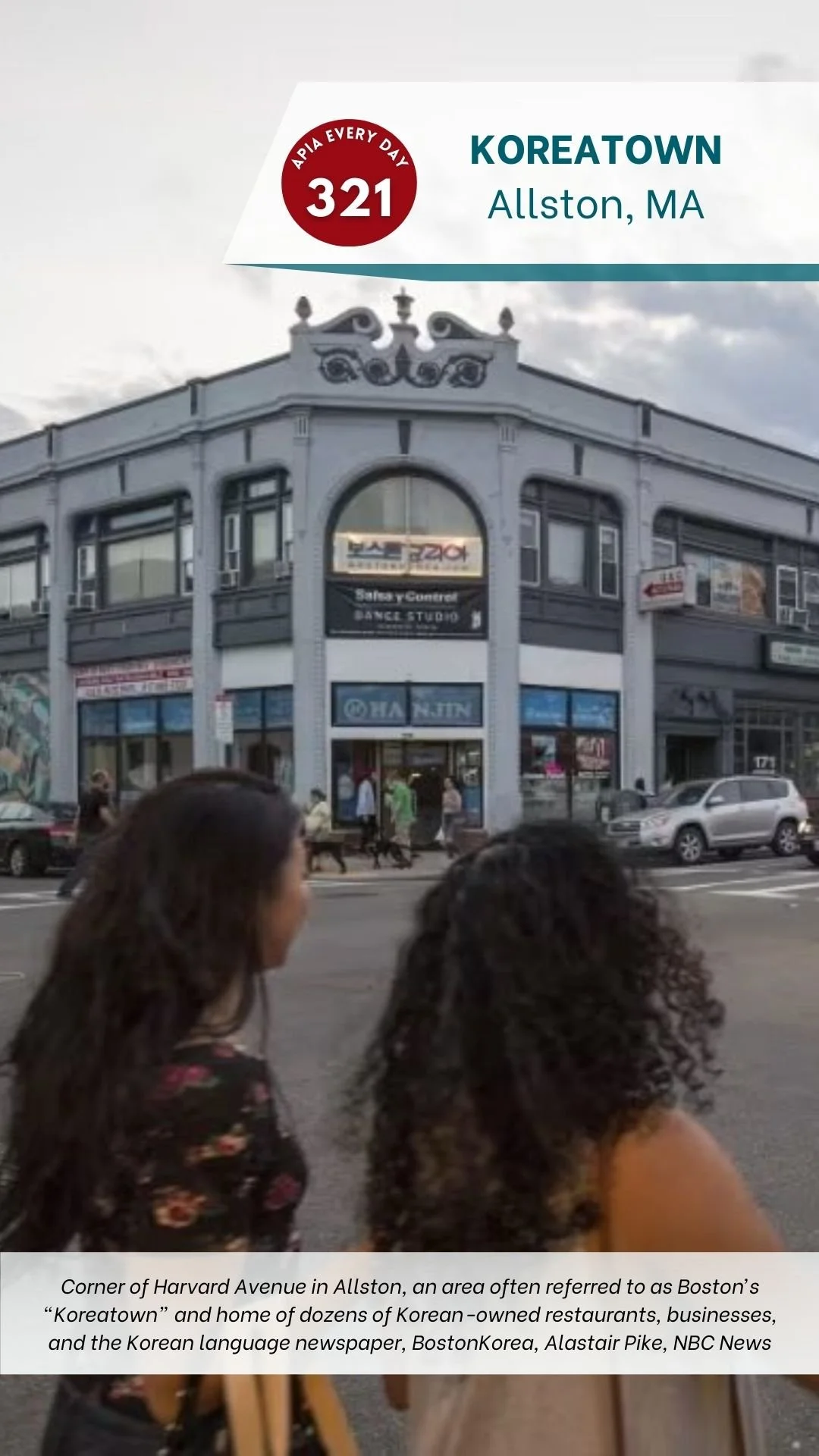
Day 321: Koreatown, Allston, Massachusetts
📌 APIA Every Day (321) - Allston is a dynamic and diverse neighborhood located in the western part of Boston, Massachusetts. Bordered by the Charles River, Brighton, and Brookline, Allston is known for its vibrant arts scene, student population, and eclectic mix of cultures. The neighborhood is closely tied to neighboring Brighton, and the two are often referred to together as Allston-Brighton. With Harvard University’s growing presence in North Allston and proximity to Boston University, the area is a bustling hub of academic, residential, and commercial activity. Allston's mixed international eateries reflect its layered urban history and multicultural identity.
In the latter half of the 20th century, Allston became a significant point of settlement for Korean immigrants, particularly during the 1970s and 1980s, when changes to U.S. immigration policy allowed for a larger influx of Korean families. As Koreans settled in the neighborhood, they established churches, grocery stores, restaurants, and community organizations that helped shape Allston's cultural and economic landscape. The area around Harvard Avenue became a cultural center, sometimes referred to as "Koreatown" by locals, though not formally designated. These Korean American communities played a key role in diversifying Allston and contributing to its reputation as a welcoming place for immigrants seeking opportunity and community in the Boston area.
Efforts to preserve Allston’s rich immigrant history, including its Korean American legacy, have emerged through both grassroots and institutional initiatives. Organizations like the Allston Village Main Streets work to support local businesses and promote cultural events that reflect the neighborhood's diverse roots. Academic institutions such as the Boston University Initiative on Cities have also explored the impact of immigration on Boston neighborhoods like Allston, documenting stories through oral histories and urban studies. No major historic landmark specifically commemorates Korean American history in Allston as of yet.

Day 320: Terminal Island, Los Angeles, California
📌 APIA Every Day (320) - Terminal Island is a small industrial island situated in the Port of Los Angeles, nestled between the cities of San Pedro and Long Beach in Southern California. Originally a tidal marsh known as Rattlesnake Island, it was gradually expanded and reshaped through land reclamation to serve as a hub for shipping, shipbuilding, and naval operations. Today, the island remains a vital site for maritime commerce and industrial activity, but its layered history also holds deep cultural significance, particularly for the Japanese American community that once thrived there.
In the early 20th century, Terminal Island became home to a vibrant Japanese American fishing village known as “Fish Harbor.” Japanese immigrants and their families developed a tight-knit community centered around the fishing and cannery industries, contributing significantly to the economic and cultural landscape of the region. However, this thriving community was abruptly dismantled following the attack on Pearl Harbor in 1941. Within days, the U.S. government forcibly removed all Japanese Americans from the island, and their homes were razed, making Terminal Island one of the first Japanese American communities to be uprooted during World War II. This tragic event marked a significant moment in the broader history of Japanese American internment and the violation of civil liberties during wartime.
In recent years, preservationists and descendants of former residents have worked to commemorate Terminal Island's unique history. Efforts include the establishment of the Terminal Island Japanese Memorial, dedicated in 2002, which honors the community that was lost during World War II. Advocacy groups, such as the Terminal Islanders Club, continue to campaign for the recognition and preservation of the island's cultural and historical legacy. These initiatives aim to ensure that the stories of the Japanese American community, their contributions, and the injustices they faced are not forgotten, even as the island continues to evolve as a hub of industrial development.

Day 319: Epworth United Methodist Church, Portland, Oregon
📌APIA Every Day (319) - The Epworth United Methodist Church, originally founded as a mission in the late-19th century, is the only Japanese Methodist church in the state of Oregon. Since its inception, the church has served as a significant religious center for Japanese Americans in Portland. Particularly in its early days, it represented a haven where Japanese Christians could freely practice their religion without facing discrimination.
In the 1890s, as Portland’s Japanese immigrant population grew, missionaries from the Japanese Methodist Episcopal Church in San Francisco were tasked with spreading evangelism to Oregon. Reverend Teikichi Kawabe headed these efforts and made multiple visits to Portland before opening the Japanese Methodist Mission in 1893 in a rented house in what is now Old Town. The mission quickly gained popularity among Portland’s Japanese residents and the congregation gained over 100 members by 1894. Eventually, the community purchased a building in 1897 to establish a ladies’ society and Sunday School. By 1903, the mission had purchased a house east of Japantown to serve as its church, and in 1919, it expanded by acquiring an adjacent dance hall.
In 1942, following E.O. 9066, Japanese residents in Portland were forced to report to the Portland Assembly Center and were transported to incarceration camps.During this time, the church closed due to the loss of its congregation. However, when Japanese community members returned to Portland in 1945, the church building was repurposed to provide housing for displaced families. At this time, under Reverend Francis Hayashi’s leadership, the Japanese Methodist Church was renamed the Epworth Methodist Church. In 1952, the congregation moved to its current location, the former site of the Grace German Methodist Church. In the 1970s, Reverend Chester Earls oversaw significant renovations and expansions to the building, adding an educational wing, dining hall, and sanctuary.
Today, the Epworth United Methodist Church continues to hold worship services and offer various community programs. In partnership with the Japanese Ancestral Society of Portland, the congregation runs initiatives like Ikoi no Kai, a lunch program providing meals to seniors, and an annual Graduation Banquet that celebrates local Japanese American high school graduates.

Day 318: Hindu Temple and Cultural Center of Birmingham, Pelham, Alabama
📌APIA Every Day (318) - The Hindu Temple and Cultural Center of Birmingham was established in 1998 in order to meet the needs of a growing Hindu community in Alabama. Following the Immigration and Nationality Act of 1965, an influx of Indian immigrants began settling in the area, initially gathering in their homes for worship. After the Hindu Temple of Atlanta opened in 1990, the need for an Alabama equivalent became clear, leading to the establishment of the Birmingham temple as a major religious center for Hindus in the city’s metropolitan area.
The idea for a temple project was first proposed by Krishna Khurana in 1993, who initiated the development of the congregation’s bylaws and constitution. Prominent community leaders, including Dr. Santosh Khare and Dr. Mahender Reddy, helped lead the temple construction effort by forming a fundraising committee. The following year, the temple organization was formally incorporated and Dr. Khare later served as its first chairman. In 1995, the decision was made to build a cultural center alongside the temple, and a five-acre property in Pelham was acquired for the site.
Construction began in 1997 after the building's design was finalized, and a groundbreaking ceremony was held in October. The temple officially opened in 1998, featuring a large worship hall designed to accommodate a broad spectrum of Vedic deities, addressing the diverse religious needs of the community. The adjacent cultural and educational center included a spacious event hall, auditorium, and classrooms.
Today, the Hindu Temple and Cultural Center of Birmingham continues to host a vibrant community. Daily worship services are held at the temple and various events celebrating cultural holidays like Diwali are hosted at the community center. Additionally, the temple offers a range of educational programs, including religious discussion groups, helping to preserve and pass down cultural traditions for future generations.

Day 317: Fort Vancouver Village, Vancouver, Washington
📌APIA Every Day (317) - Between the 1820s and 1840s, Fort Vancouver in the Oregon Territory was home to a multiethnic village including a significant population of Native Hawaiian residents. As a fur trading post, the Fort served as the commercial headquarters of the prosperous Hudson’s Bay Company (HBC). Hawaiian laborers had been working for HBC as ship crew members as early as 1821, facilitating trade between the Oregon Territory and Hawai’i. Over time, many of these Native Hawaiians settled at the Fort, taking on local jobs and establishing homes in the surrounding area.
The village that developed outside the stockade walls of Fort Vancouver—often referred to as "Kanaka Village" due to its large Hawaiian population—became a community of various ethnic groups, including Hawaiians, Métis, and Indigenous Americans. Residents were expected to construct their own residences out of whatever material they could salvage. An estimated number of 40 to 60 houses were built in the area and the Hawaiian residents numbered possibly as high as 138 in 1844—representing nearly a third of the village’s total population.
Some Hawaiian men lived in the village seasonally, working as sailors for the HBC, while around 50 to 60 Hawaiians made the Fort their permanent home. They worked in various roles, such as sawmill laborers, servants, farmers, soldiers, and cooks. Within the village, it was common for single Hawaiian men to marry Native American women, forming multiethnic families. Many of these men opted to stay in the Northwest with their new families rather than return to Hawai’i once their labor contracts were fulfilled.
One of the most notable Hawaiians in the village was William Kaulehelehe, a Methodist preacher hired by the company in 1845. Along with his wife, Mary Kaai, he became a key figure in ministering to the Hawaiian community at the Fort. Kaulehelehe established a small church and schoolhouse, called “Owyhee Church,” within the Fort’s walls. The couple was the only Hawaiian family to live within the Fort compound after they moved from their previous home in the village. Eventually, the couple’s old home, along with the rest of the village, was destroyed due to fire in 1960 after the U.S. Army occupied the site.
In 1966, Fort Vancouver was added to the National Register of Historic Places, however, the original buildings of the village no longer exist. Instead, reconstructed cabins outside Fort Vancouver provide a glimpse into the lives of early HBC laborers on the site. Archaeological work at the Fort is ongoing, uncovering more artifacts like ceramic jars at the location of Kaulehelehe and Kaai’s demolished village house, to better understand the early Native Hawaiian history at the compound.

Day 316: Ghadar Memorial Hall, San Francisco, California
📌APIA Every Day (316) - The Ghadar Memorial Hall in San Francisco once served as the Ghadar Party’s headquarters circa 1913 to 1917. This political movement, founded mainly by North American Punjabi Sikh immigrants, along with Hindu and Muslim East Indians, sought to free India from British colonial rule. The term "ghadar" translates to "mutiny" or "revolution," reflecting the party's mission. From the San Francisco Hall, Ghadar activists spread word of their cause through an international newspaper.
San Francisco’s sizable Indian population, combined with the influence of party leader Har Dayal in the area, made the city a natural base for the Ghadar Movement. The party’s first headquarters, also referred to as Yugantar Ashram, was established in 1913 and the organization published the first edition of their newspaper that same year. Titled “The Ghadar,” the publication highlighted the struggle and need for Indian independence. Some unspecified time later, the headquarters was moved to the current location of the Ghadar Hall at 5 Wood Street. The three-story building, also known as the Ghadar Ashram, provided space for party members to organize secret meetings and run their printing press.
The start of World War I in 1914 marked the beginning of the Ghadar Conspiracy which encouraged Indians abroad to return and start a rebellion in British India. However, British intelligence learned of these plans, and most of the 150 Ghadarites on the first mission were arrested. Over the years, more attempts were made, but many of the 8,000 North American Indian immigrants involved were arrested, and some were hanged by the British Raj. In 1917, American officials tried Ghadar Party members in the District Court of San Francisco for disrupting the United States’ neutrality with Britain. Known as the Hindu-German Conspiracy Trial, it was the longest and most expensive trial in U.S. history at the time.
After the trial, with many of the remaining U.S. members serving prison sentences, the Ghadar Party slowly subsided. When India eventually did achieve independence in 1947, the U.S. Consulate transferred the San Francisco Ghadar Ashram over to the Indian government in 1949. Restoration efforts began in 1952 as the local Indian community and the Indian government raised funds for the building’s repairs. In 1975, the Ghadar Memorial Hall was inaugurated. A Memorial Library was added the following year, dedicated by India's Minister of External Affairs, Yashwantrao Chavan.
Today, the Ghadar Memorial Hall stands as a testament to the sacrifices made by North American Ghadar activists in their fight for Indian independence. The Indian Consulate occasionally organizes events at the Hall to commemorate holidays like Indian Independence Day and Republic Day. In 2019, the Consulate signed an agreement to restore and transform the Memorial into a museum, though significant progress has yet to be made.

Day 315: Republic Café and Ming Lounge, Portland, Oregon
📌APIA Every Day (315) - The Republic Café, one of Portland's oldest continuously operating Chinese restaurants, initially opened circa 1930. Located in the city’s Chinatown district, the café was housed in the O.B. Stubbs Building alongside other Chinese businesses and organizations like the Hop Sing Tong Association. For early Chinese Americans, the café and lounge served as a social center, where people could gather and enjoy cultural dishes.
In its early years, the café primarily served Cantonese cuisine as the owners were from the Guangdong province of China. A popular Americanized dish included Chop Suey, a meal prepared with meat and a variety of mixed vegetables. In 1939, Sam Soohoo, who had immigrated to the U.S. in 1928, became the principal owner and head chef of the business. By the 1940s, the café was located in a prime food neighborhood, surrounded by prominent Japanese eateries like the Tokio Sukiyaki House and Yodogawa Restaurant.
In the 1950s, Dr. Victor Wong became a minor partner and helped secure a liquor license for the Republic Café in 1951. With this new development, Soohoo opened the Ming Lounge to serve alcoholic drinks, and revamped the restaurant’s interior with Chinese decorative motifs. Through the 1970s, the café continued to thrive, serving a variety of signature Cantonese dishes. While other clubs and restaurants in the area closed early, the Republic stayed open until 4 a.m., attracting busy crowds of customers. During this time, the café quickly became known as one of the best Chinese restaurants in Portland and was often frequented by important public figures and celebrities. Dr. Wong, who had later become the manager of the restaurant, was referred to as the unofficial “Mayor of Chinatown.”
In 1989, the Republic Café and Ming Lounge were added to the National Register of Historic Places as part of the Portland New Chinatown/Japantown Historic District. Although Soohoo and Wong sold the restaurant to new owners in 1979, it continues to operate and serve Cantonese food today. Now managed by the Mui family, the café hosts a variety of cultural events, including art shows, live bands, and maker fairs in its gallery and lounge spaces.

Day 314: Canacka Boarding House, Nantucket, Massachusetts
📌 APIA Every Day (314) - The Canacka Boarding House, located in Nantucket's New Guinea historic neighborhood, played a significant role in the island's maritime history. Established in the 19th century, this boarding house provided lodging for Pacific Islander sailors, particularly those from Hawai’i and Aotearoa, who were integral to Nantucket's whaling industry. Nantucket, an island off the coast of Massachusetts, was a prominent whaling hub during the 18th and 19th centuries. Historically, the New Guinea neighborhood was a community built by formerly enslaved African Americans that gradually evolved into a multicultural space.
Within this community, the Canacka Boarding House emerged as a vital establishment for transient seamen from the Pacific Islands. The boarding house was operated by William and Maria Whippy. William Whippy, born in Aotearoa in 1801, was likely the son of a Nantucket whaleman and a Māori mother. His wife, Maria, was the daughter of James Ross, an African-born resident of Nantucket. The Whippys' establishment served as a haven for Pacific Islander sailors who arrived in Nantucket aboard whaling vessels, offering them a sense of community and belonging far from their ancestral homelands.
The boarding house provided lodging and represented the multicultural fabric of Nantucket during the whaling era. The site represents the island's diverse population and Pacific Islander mobilities, which included significant numbers of Native Hawaiian and other Pacific Islander sailors between 1820 and 1860. While the original structure of the Canacka Boarding House no longer exists, its legacy is preserved through various historical artifacts and initiatives. Notably, the sign from the boarding house is part of the Nantucket Historical Association's collection, serving as a tangible reminder of the island's diverse maritime heritage.

Day 313: Yee Pat Ling’s Restaurant, Temple, Texas
📌 APIA Every Day (313) - Yee Pat Ling was a Chinese immigrant who arrived in the United States in the early 20th century, a time when Chinese immigrants faced significant challenges, particularly in the southern and western parts of the U.S. He settled in Temple, Texas, where he would go on to establish one of the first Chinese restaurants in the area. Born in China, Yee Pat Ling, like many of his compatriots, sought better economic opportunities in America, driven by the promise of prosperity, especially after the completion of the transcontinental railroad and the growth of cities. In a period when Chinese immigrants often faced discrimination and were relegated to niche occupations, Yee Pat Ling’s work in the restaurant industry became a testament to the perseverance and resourcefulness of Chinese immigrants in the face of adversity.
Yee Pat Ling's restaurant played a significant role in the broader history of Chinese immigrants in Texas, a state where the Chinese community began to grow primarily in urban centers during the late 19th and early 20th centuries. As with many other Chinese-owned restaurants, Yee Pat Ling’s establishment served as both a place of business and a cultural hub for the local Chinese community, offering not just food, but a sense of belonging and identity in a predominately white society. The restaurant was more than a simple eatery; it symbolized the resilience of Chinese immigrants who were carving out a space for themselves within American society. In the context of Texas, where Asian populations remained relatively small compared to other ethnic groups during this time, Yee Pat Ling's restaurant contributed to the growing presence and little-known contributions of the Texan Chinese community.
In 2014, the Texas Historical Commission has sought to memorialize Yee Pat Ling’s contributions to Temple, Texas through a historical plaque located at Hillcrest Cemetery, where Mr. Ling is buried. Additionally, local historical societies, in collaboration with community members, have worked to ensure that Yee Pat Ling’s legacy is not forgotten. Efforts to mark the site where Yee Pat Ling's restaurant once stood, along with storytelling projects, have aimed to elevate his role in the development of Temple's social and cultural fabric.

Day 312: Wat Khmer Buddhist Temple, Long Beach, California
📌 APIA Every Day (312) - The Wat Khmer Buddhist Temple in Long Beach, California, is a significant cultural and spiritual landmark for the local Cambodian community. Established in 1980, the temple serves as a place of worship, cultural preservation, and community gathering. Its founding was driven by the needs of the Cambodian refugees who had fled the Khmer Rouge regime in the 1970s, seeking asylum and new lives in the United States. As a symbol of both religious practice and cultural identity, the Wat Khmer Buddhist Temple not only offers spiritual services but also provides a safe space for Cambodian immigrants to connect with one another, maintain their heritage, and support their community through various programs and events.
The Wat Khmer Buddhist Temple is deeply intertwined with Long Beach's Cambodian immigrant history. In the aftermath of the Khmer Rouge genocide, many Cambodian refugees found their way to California, particularly to Long Beach, which became home to one of the largest Cambodian populations in the United States. The temple, located in the heart of this community, became a vital institution for these new immigrants. For many, the Wat Khmer Buddhist Temple was the first point of contact with their cultural and religious roots in a new environment. It became a center where they could practice traditional Cambodian Buddhism, celebrate religious holidays, and find a sense of community and belonging. Over time, the temple has not only served as a spiritual sanctuary but also as a cultural hub, offering classes in Cambodian language, dance, and music, helping to preserve and transmit Cambodian traditions to younger generations.
Given that Southeast Asian refugee communities like Cambodians in Long Beach have settled in the past forty years, we reflect on whether and how historic preservation practices are prepared to recognize these neighborhoods and their cultural institutions as significant narratives of larger American historic landscapes.

Day 311: Historic Chinatown, Anchorage, Alaska
📌 APIA Every Day (311) - The history of Chinese immigration to Alaska dates back to the late 19th century, when Chinese laborers first arrived in the region during the gold rush and salmon cannery industry. The Chinese were part of a larger wave of immigrants who came to the U.S. in search of economic opportunities, driven by the promise of prosperity in booming industries. Many Chinese immigrants initially found work as railroad laborers, miners, and in various service industries. Over time, they became an integral part of the growing economy of Alaska, contributing not only through labor but also by establishing businesses that catered to the needs of a rapidly developing region. As with other parts of the U.S., Chinese immigrants in Alaska faced racial discrimination and exclusionary policies, but they built resilient communities despite these challenges.
In the early 20th century, the establishment of a "Chinatown" in Anchorage was directly tied to the labor needs of the burgeoning cannery industry. Chinese immigrants played a critical role in the canning operations that flourished along Alaska's coast, particularly in the fishing industry. These workers, many of whom were employed in the canneries and salmon processing plants, created tight-knit communities where they could maintain their cultural traditions while contributing to the local economy. Anchorage, as a central hub for these industries, became home to a small but vibrant Chinatown, where Chinese immigrants and their families lived, worked, and conducted business. Despite the lack of large-scale infrastructure for the Chinatown in the traditional sense, the area was marked by Chinese-owned shops, restaurants, and small businesses that served both the local population and the labor force at the canneries.
Preserving the history of Anchorage's "Chinatown" has been an important effort in recent years, as the community's contributions to the city’s development have often been overlooked in broader narratives of Alaskan history. Academics and community organizations began working to document and memorialize the stories of Chinese immigrants in Anchorage, focusing on the cultural and social legacy of the Chinatown district. Given that historic preservation efforts have been largely public history-based, how might current historic preservation practices preserve this small, but rich ethnic enclave that once existed and contributed significantly to the Alaskan salmon industry?