

APIA Every Day is our commitment to learning and sharing about historic places significant to Asian & Pacific Islander Americans, every day.
Follow Us →

Day 290: Little Punjab, Richmond Hill, New York
📌APIA Every Day (290) - New York’s Richmond Hill neighborhood, which encompasses Little Guyana (APIA Every Day 187), is also home to a community around 101st Avenue known as Little Punjab. This area of Queens has long been occupied by South Asians, many of them second and third wave immigrants, who arrived in New York following India’s independence and U.S. immigration law reforms in the 1960s. The 1980s in particular, brought an influx of Punjabi Sikh immigrants seeking refuge from government persecution in the aftereffects of Partition which divided Punjab between India and Pakistan. Richmond Hill provided space for this growing Punjabi community in New York to find support and connection amidst a backdrop of businesses that were reminiscent of home.
Little Punjab experienced considerable growth in the 1990s as more Sikh families gathered around the area's first Gurdwara Sahib—The Sikh Cultural Society Temple—which opened in 1972. Recognized as one of the oldest gurdwaras on the East Coast with organizational roots in 1954, the current temple that sits on the site today was built in 2004 after a fire destroyed the original building in 2002. The second major gurdwara in the area, the Baba Makhan Shah Lubana Sikh Center, was founded in the late 1990s and stands just a few blocks away. Beyond these core religious institutions, Little Punjab is also home to a number of South Asian businesses selling traditional foods, clothing, and jewelry. Notable establishments include restaurants like Punjabi Dhaba and Punjabi Kabab House as well as grocery stores like Apna Bazaar. Signs across these businesses appear in both English and Punjabi Gurmukhi: the writing system used by Sikhs from Eastern Punjab.
In recent years, Little Punjab has gained more official recognition from the city for its historical and cultural significance. In 2020, the length of 101st Avenue between 111th and 123rd streets was officially co-named Punjab Avenue. That same year, a portion of 97th Avenue near the Sikh Cultural Society Temple became Gurdwara Street. In 2023, a section of the intersecting 118th Street was designated Guru Nanak Way, honoring Sikhism's founder. Today, Little Punjab remains a lively, multiethnic neighborhood which continues to celebrate and promote South Asian culture through its businesses and events like the annual Sikh Day parade.
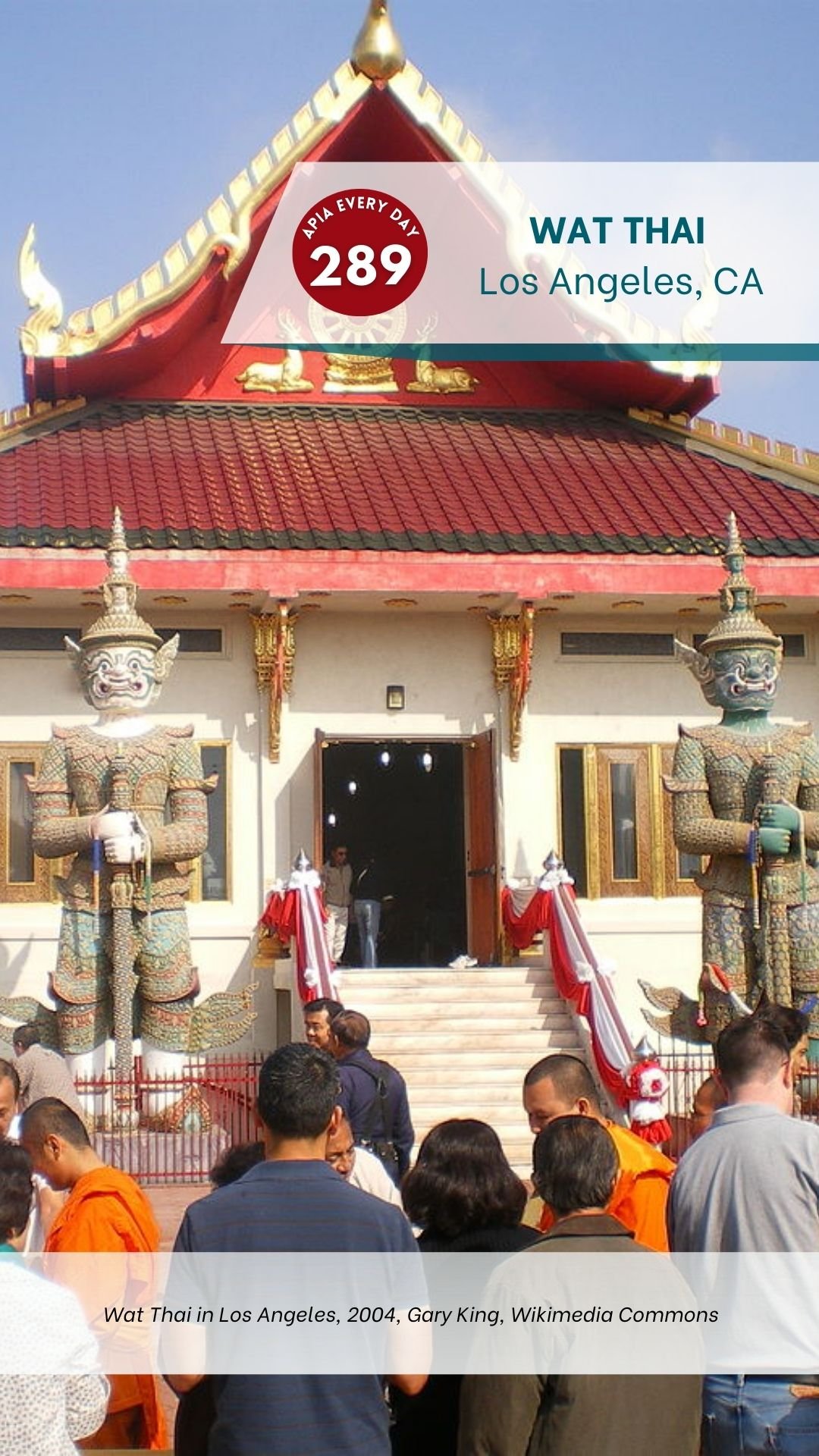
Day 289: Wat Thai, Los Angeles, California
📌APIA Every Day (289) - Located just outside of Los Angeles’ Thai Town (APIA Every Day 36), the Wat Thai was the first Thai Buddhist temple established in the United States in 1979. Thai immigrants had been settling in Southern California since the 1950s, primarily coming to pursue education at American universities. In the 1980s, as more working-class Thai immigrants settled in Los Angeles and opened businesses, the Thai community established more permanent roots in the city. The Wat Thai played an important role in fostering Thai Town's cultural development and providing a central space for community members to gather.
The Thai community's desire to establish a Buddhist temple in L.A. led to the incorporation of the Thai-American Buddhist Association in 1970. The following year, Buddhist monks were invited from Thailand to help organize efforts to found a temple. Shortly after, two committees—one based in L.A. and one based in Bangkok—formed to fund the burgeoning project. In July of 1971, a single family home was purchased by the committees to serve as both a residence for monks and a temporary worship space, marking Wat Thai's unofficial beginning.
Later in 1972, the site for a more formal temple was purchased on Cantara Street. The property encompassed 2.2 acres of land and a plan was set out to develop a temple monastery complete with worship space, living quarters, and other sacred buildings. That year, construction began with the placement of the foundation stone for the traditional Thai-style main hall, the Uposatha-Sala. The building's completion was marked in 1979 with a ceremony to mount its gable spire, attended by the Sangharaja Somdej Phravanarat—the head of the Thai Buddhist community. In 1982, the Sangharaja returned to consecrate the main hall, officially establishing the Los Angeles temple as a monastery under the Sangha (the Buddhist monastic order). During this time in the ‘80s, the temple community also initiated its ongoing tradition of organizing an outdoor food court for visitors each weekend.
Since its founding, the temple has maintained its role as a cultural center, celebrating annual Thai festivals, operating a Buddhist Sunday School, and offering meditation and vocational training to community members. The Wat Thai also remains a source of pride for Thai Americans, recently hosting a visit from Thailand's current prime minister, Paetongtarn Shinawatra, in 2024. While not yet registered as a historic site, the temple was included in the 2018 Los Angeles Historic Context Study on Thai Americans as a potential local nomination property.
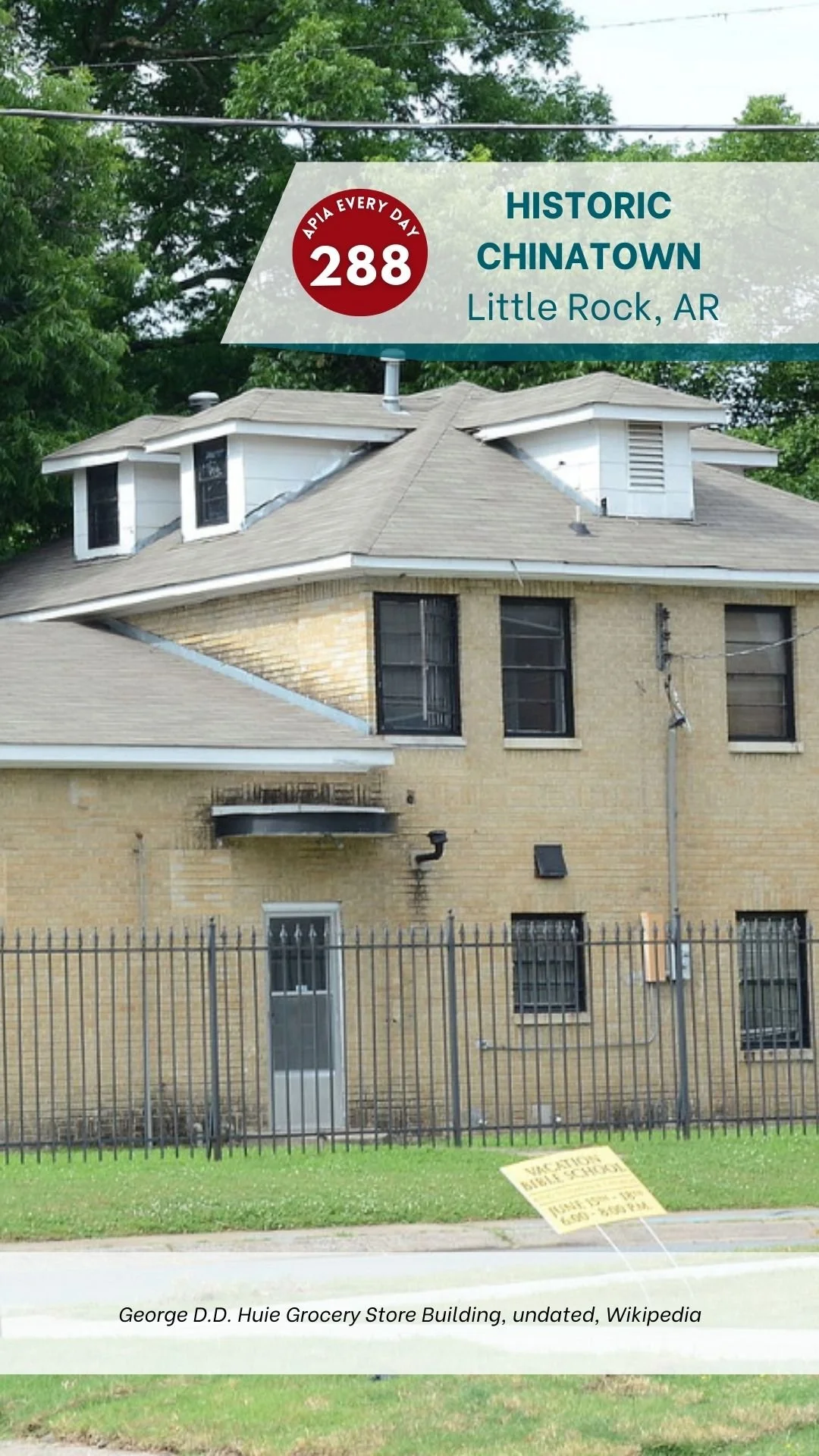
Day 288: Historic “Chinatown”, Little Rock, Arkansas
📌 APIA Every Day (288) - Little Rock “Chinatown”, located in the capital city of Arkansas, was once a small but significant enclave for Chinese immigrants in the late 19th and early 20th centuries. Situated near the heart of the city, the Chinatown area was a vibrant community that supported Chinese-owned businesses, such as laundries and grocery stores. Though now largely forgotten in mainstream American history, Little Rock Chinatown and neighboring counties played an important role in Arkansas’ commercial and cultural life, providing a space where Chinese immigrants could create a sense of community. Little physical evidence remains of the original Chinatown, the stories and legacy of the community continue to be an important part of Little Rock’s cultural history.
The history of Little Rock Chinatown traces back to the late 1800s when Chinese laborers, mostly male immigrants, arrived in the city seeking economic opportunities following the construction of the transcontinental railroad and the Gold Rush. Chinese laborers were recruited to address the labor shortages across American Southern plantation economies during the Reconstruction period. This plan failed as Chinese workers eventually left these plantation sites to start mostly laundries and grocery stores in historic Black neighborhoods. Some Chinese also served as cooks and opened up their own restaurants in Arkansas. Despite facing considerable discrimination and legal restrictions, the small Chinese community that remained in the area flourished, establishing businesses, social networks, and institutions.
Many of the initial Chinese laborers who remained settled in Arkansas through intermarriage or by bringing their families from China. Thus, the Chinese population grew considerably with newer waves of migration throughout the 20th century. These mobilities made way for newer institutions, such as language schools for the American-born Chinese in Arkansas, churches such as the Little Rock Chinese Christian Church, which served as a community center, and the creation of the Chinese Association of Arkansas.
Today, the memory of Arkansas’s “Chinatown” exists primarily through oral histories, archival documents, and the efforts of local universities and Chinese American organizations to preserve its legacy. However, one grocery store in Little Rock’s Chinatown was listed on the National Register of Historic Places in 2005: George D.D. Huie Grocery Store Building. Located at 1400 North Pine Street in North Little Rock, Arkansas, the building that hosted the grocery store was built by George Huie, a Chinese immigrant. The store was historically important for the growth and development of the local Chinese community and for its service to the historic African American neighborhood in which the grocery store was located. Given that Little Rock Chinatown history has largely been forgotten, how might historic preservation practices expand to include Asian histories across the American South where, instead of officially designated Chinatowns, small, dispersed Chinese communities existed and contributed to local economies and culture?

Day 287: Manenggon Camp, Yona, Guam
📌 APIA Every Day (287) - Manenggon Camp, located between the villages of Yona and Talo’fo’fo on the island of Guam, is a historical site that holds deep significance to the people of Guam. It is primarily known as the location where over 20,000 CHamoru civilians were incarcerated by the Japanese military during World War II, between 1944 and 1945. The campsite, situated in a lush, forested area, is marked by a memorial to honor the lives affected by wartime imprisonment and suffering. Manenggon Camp is a key historical landmark for those seeking to understand the hardships endured by the CHamoru people during the war, as well as the broader impact of Guam’s occupation during the conflict.
The history of Manenggon Camp is rooted in the brutal occupation of Guam by the Japanese military, which began in 1941 and lasted until the American recapture of the island in 1944. During this time, the CHamoru population faced extreme violence, displacement, and forced labor. The hardship intensified when the Japanese military forced civilians to march to a remote area between Yona and Talo’fo’fo, aiming to control the CHamoru population ahead of the American military’s impending arrival. The conditions at the camp were harsh, with inadequate food, shelter, and medical supplies. Many suffered from disease, malnutrition, and the trauma of displacement. After the liberation of Guam by American forces in 1944, Manenggon Camp became a site of remembrance, symbolizing the suffering of the CHamoru people during the war.
The site of Manenggon Camp is an important reflection of the CHamoru people's connection to the land and their resilience through history. The loss of land, livelihood, and family ties due to the incarceration created a profound sense of displacement. However, the site also embodies the CHamoru people’s enduring connection to their ancestral roots, as it represents both a painful chapter in their history and a testament to their survival and strength. The recognition of Manenggon Camp as a National Historic Landmark in December 2024 as a site of memory and respect is part of a larger effort to heal and reconnect with the land, ensuring that the stories of those who suffered there are never forgotten.
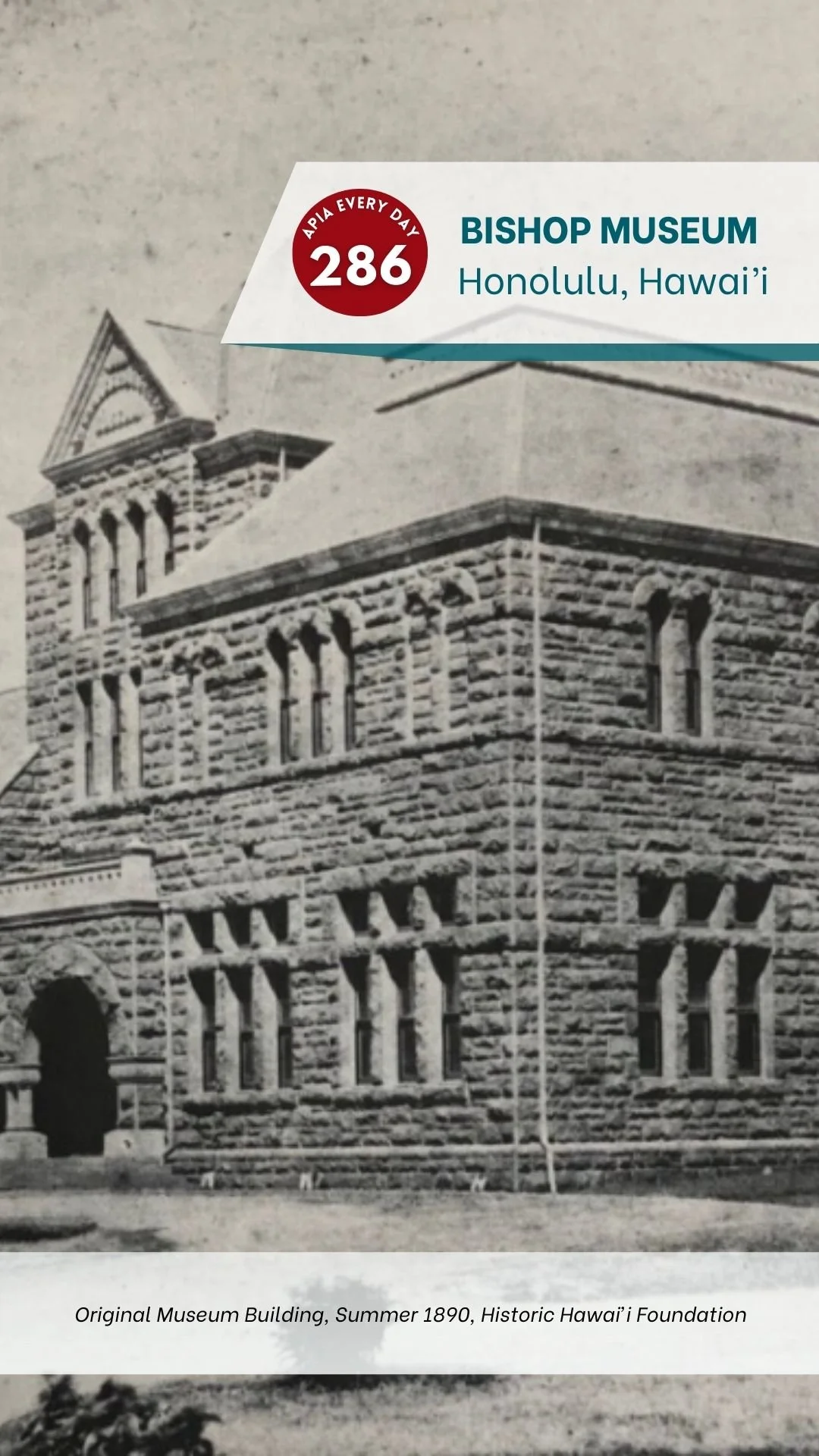
Day 286: Bishop Museum, Honolulu, Hawai’i
📌 APIA Every Day (286) - The Bishop Museum, located in Honolulu, Hawai'i, is a significant cultural institution dedicated to preserving the natural and cultural history of Hawai'i and the Pacific. Established in 1889, it houses an extensive collection of artifacts, manuscripts, and specimens that reflect the rich diversity of the Hawaiian Islands and the greater Pacific region. The museum's campus includes the main building and the adjacent J. Watumull Planetarium, as well as a variety of outdoor exhibits. Its educational programs and research facilities serve as vital resources for scholars and visitors alike, offering a deeper understanding of Hawaiian heritage and its connection to the Pacific.
The Bishop Museum's history is intertwined with the legacy of Charles Reed Bishop, a businessman and philanthropist who founded the institution in memory of his late wife, Princess Bernice Pauahi Bishop, the last direct descendant of Kamehameha the Great. Initially, the museum's primary mission was to house and showcase the royal family's collections, but it quickly expanded to include a vast array of scientific and cultural exhibits. Over the years, the museum has grown in scope, acquiring important collections related to Hawaiian ethnology, archaeology, and natural sciences, as well as rare documents that chronicle Hawai'i's history before and after European contact. It remains a pivotal institution in Hawai'i, preserving the cultural identity and history of the islands for future generations from Native Hawaiian perspectives.
In 1980, the Bishop Museum was nominated to the National Register of Historic Places Inventory. One of the halls in the Museum, Pacific Hall, received a Preservation Award from the Historic Hawai’i Foundation in 2014 after undergoing extensive rehabilitation that was completed in 2012. The Bishop Museum’s location on O'ahu is deeply symbolic of Hawaiian cultural traditions that emphasize the importance of the land, or āina, and its stewardship. In ancient Hawai'i, knowledge and practices were rooted in the local environment, with each place holding specific significance through spiritual and practical relationships. The museum’s focus on preserving the island's natural history and cultural practices reflects the Hawaiian concept of malama ‘āina—to care for and protect the land. Just as Native Hawaiians honored the landscape through their careful cultivation, ritual practices, and oral traditions, the Bishop Museum serves as a contemporary representation of this land stewardship, connecting the community to its ancestral knowledge and fostering a deeper understanding of people and place.

Day 285: I Wor Kuen, Manhattan, New York
📌 APIA Every Day (285) -The I Wor Kuen (IWK) New York City Office Building on 24 Market Street, located in Chinatown, Manhattan, holds significant historical and cultural relevance as a hub for the Chinese American revolutionary movement in the 1970s. The office was the base of operations for I Wor Kuen, a Marxist-Leninist organization that emerged from the Chinese American community in the United States. The organization was deeply involved in advocating for the rights and political empowerment of Chinese immigrants, fighting against racial oppression, and working toward social and economic justice. The office served not only as a meeting point for its members but also as a space for organizing, activism, and discussions about revolution, identity, and solidarity within the larger context of Asian American and working-class struggles.
The I Wor Kuen organization itself was founded in the early 1970s, initially as part of the broader wave of leftist political movements during the era, including the Black Panther Party and other radical groups. The group's activities were centered around labor organizing, anti-imperialism, and raising awareness of issues such as community health, housing discrimination, poor working conditions, and the exploitation of Chinese immigrant workers. The New York City office played a critical role in these efforts, acting as a focal point for collaboration and community building. However, as political dynamics shifted in the late 1970s, the organization eventually dissolved.
The I Wor Kuen New York City Office represents a vital intersection between activism and the specific needs and struggles of the Chinatown community. The office itself was not just a political headquarters but a site that reflected the values of solidarity and cultural pride, mirroring how Chinese immigrant communities in New York have long relied on localized support systems to navigate racial discrimination and socio-economic hardships. The office, like other historic places of activism in immigrant communities, reflects a place-based ethic of care, resilience, and transformation—where people come together to create change that directly impacts their lives. Although no historic preservation efforts exist to preserve the building, its role as a community organization space reflects IWK's broader efforts to protect Manhattan's Chinatown and its residents from displacement, contributing to the larger social histories of the community.

Day 284: Humåtak Outdoor Library, Humåtak, Guam
📌APIA Every Day (284) - The Humåtak Outdoor Library was the first public library established in southern Guam in 1933. As building materials were scarce at the time, CHamoru community members volunteered their own labor to construct a small gable-roofed structure with open air bookshelves that allowed residents to obtain and return books on an honor system. This library was the only space that provided English literature to school children in the area and highlights the resourcefulness of CHamoru leaders in making education more obtainable for their community.
In the early years of American Naval rule over Guam, the island’s education system was in an inadequate state. In 1910, only 1,715 students were enrolled in schools across the island—a number that declined further the following year. Enrollment started to improve within the next decade as more schools were constructed and as the government hired more teachers, including prominent Humåtak educator Francisco Quinata Sanchez. In the 1930s, amidst the Naval government’s establishment of two segregated American schools barring CHamoru students from attendance, Sanchez designed the Outdoor Library adjacent to Humåtak’s school building. Local Naval personnel donated books for the shelves and the library opened in 1933 with complete accessibility to the entire community.
Recognizing the Humåtak Outdoor Library’s connection to Francisco Quinata Sanchez and its significance to the CHamoru community, the site was added to the National Register of Historic Places in 1999. After falling into disuse and disrepair, the library was rehabilitated in 2014 by the Humåtak Community Foundation and Guam Preservation Trust. The neighboring Francisco Q. Sanchez Elementary School (APIA Every Day 148), dedicated in honor of the educator in 1953, is currently also being restored after receiving $3.5 million in rehabilitation funds in 2022. Although the Outdoor Library is no longer in use today, it stands as a historic monument to Humåtak's past, alongside the F.Q. Sanchez School, commemorating the CHamoru community's advocacy for accessible education.

Day 283: Chinese Tong Houses, Maui, Hawai’i
📌APIA Every Day (283) - The Chinese Tong Society is a fraternal organization with ties to the 17th-century Hung Men (Hoong Moon) Society of China. When Chinese immigrants came to Hawai'i as contracted sugar plantation workers, they established over thirty society houses across the Islands (APIA Every Day 280)—including six on Maui between 1900 and 1910. By the late-20th century, only three of these six original Tong Houses remained standing: the Chee Kung Tong Society House in Wailuku, the Ket Hing Society House in Keokea, and the Wo Hing Society House in Lahaina. Functioning as mutual-aid organizations, the Chinese Tong Houses supported their members' various recreational, cultural, and financial needs.
All three Tong Houses in Maui shared the same general design despite their different locations: each were two-story wooden structures with gable roofs and wrap-around verandas. The Chee Kung Tong and Wo Hing Societies both formed in 1905 and established their clubhouses the same year. Though the Ket Hing Society was incorporated earlier in 1900, it didn’t construct and occupy a society house until 1907. The two-story design of the society houses served a distinct purpose: the ground floor housed public meeting halls where everyone—including women and children—could gather for community events and Chinese festivals. The upper floor was reserved for society members, men aged 16 to 60, who gathered for gambling, opium smoking, gardening, and reading newspapers. Activities at the Ket Hing Society were more politically inclined, with Sun Yat-Sen—the first provisional president of the Republic of China—being an established member since 1903.
The three Tong Houses were collectively added to the National Register of Historic Places in 1982, recognizing their significance to Chinese-Hawaiian history and community life. However, due to poor building maintenance, the Chee Kung Tong House collapsed in 1996. The Wo Hing Society House, renovated in 1983, became the Wo Hing Chinese Museum and remained the best-preserved clubhouse until it burned down in the 2023 Maui wildfires. Today, only the Ket Hing Society House—now known as the Kwock Hing Society Hall—remains as a testament to the history of Chinese immigrant organizations on the island. The building welcomes visitors and continues hosting cultural celebrations, single-handedly preserving the legacy of Maui's society halls for future generations.

Day 282: Hollywood Sikh Temple, Los Angeles, California
📌APIA Every Day (282) - The Hollywood Sikh Temple, originally known as the Vermont Gurdwara, was established in 1969 as the first Sikh temple built in the U.S. following India's independence. The gurdwara’s construction was prompted after the 1947 Partition of India divided the region of Punjab and led to increased Sikh immigration to California. The temple has long since served as a cultural center and religious haven for the Sikh community in the Los Feliz neighborhood and the greater Los Angeles area.
In the 1960s, prior to the temple's establishment, community members would congregate at the home of prominent community leader, Dr. Amarjit Singh Marwah. At the time, the only established gurdwaras in the area were in Stockton (APIA Every Day 89) and El Centro, requiring long commutes for those who lived in L.A. In 1969, Dr. Marwah purchased a small hotel to use as a temple, commemorating the 500th birth anniversary of Sikhism's founder, Guru Nanak. The hotel, originally a small single-family home, was then converted for worship services and community gatherings. In November of that year, Councilman Tom Bradley inaugurated the temple, giving the Los Angeles Sikh community a gurdwara of their own.
As more Sikh refugees arrived in the U.S. during the 1980s and 1990s, fleeing persecution from the Indian government, the community decided in 1986 to build a larger temple on the site. After seven years of fundraising, the current two-story gurdwara opened in 1996, featuring a new worship space, community kitchen, classrooms, and a library. Between 2016 and 2019, supported by Dr. Marwah, the temple underwent renovations to add additional educational spaces and prayer rooms to the existing building.
In 2019, the square outside the gurdwara, at the intersection of Vermont and Finley Avenues, was dedicated to Dr. Marwah for his contributions to the Sikh community and his service to Los Angeles as a city commissioner. Later in 2023, recognizing the longstanding significance of the site to Sikh Americans, the Los Angeles City Council designated the temple as a Historic-Cultural Monument. Since its founding, the temple has continued to be an anchor for the local community: offering prayer services, organizing education programs, and hosting cultural events to preserve Sikh heritage.

Day 281: Filipino Community Center, Seattle, Washington
📌APIA Every Day (281) - The Filipino Community of Seattle (FCS) is one of the earliest Filipino associations founded in the U.S. providing support to Filipino immigrants. At the time of its incorporation in the 1930s, Seattle had a sizable Filipino population numbering around 1,600 residents. As this population grew, the FCS opened a Filipino Community Center in 1965 which has remained a central gathering place for the local Filipino community for over half a century.
The initial idea for a Filipino community association in Seattle began with a group of Filipino students at the University of Washington. In 1927, they formed a committee and began fundraising to purchase a building under the name of the Seattle Filipino Community Clubhouse. When the Philippine Commonwealth Government was established in Manila in 1935, organizers formed a more formal association called the Philippine Commonwealth Council of Seattle (PCCS). The PCCS celebrated the Commonwealth inauguration with a two-day celebration and elected Pio de Cano as their first organization president.
In 1946, as the Philippines gained independence, the PCCS was reincorporated as the Filipino Community of Seattle. In 1965, the FCS purchased an old bowling alley along MLK Jr. Way South in Rainier Valley to establish its first formal meeting space—the Filipino Community Center (FCC). Filipino architect Armando Rollolazo helped to renovate the building, which opened later that November. In the following years, the center launched various social programs that still continue today—including the Senior Lunch Program and the Youth Empowerment Program.
From 2003 to 2008, the FCC underwent major renovations to expand and update its facilities. The renovated center, completed in May 2008, included new classrooms, offices, a library, and a redesigned main hall. During this time, the FCS Board also committed to building the Filipino Community Village—an affordable housing complex for seniors and an expansion of the community center. The apartment building was completed in 2021 and successfully opened alongside the Innovation Learning Center computer lab. Currently, plans to expand the Community Village are underway.
From its early origins as a student clubhouse to a repurposed bowling alley, the Filipino Community Center has evolved into a large institution that provides senior services, youth education, and cultural engagement activities for the local community. For the 60 years since its establishment, the FCC continues to be an important social support hub for Filipinos living in Seattle.

Day 280: Parcel C, Boston, Massachusetts
📌APIA Every Day (280) -Chinatown is a nine-block area in the heart of Boston, housing long-time residents, small business owners, and new immigrants alike. Despite its size, the land holds a deep history in which Tufts University is implicated. In early 1993, the Tufts-New England Medical Center (T-NEMC) made an offer to the Boston Redevelopment Authority (BRA) to build a garage complex on a small plot in Chinatown. T-NEMC is the official partnership between Tufts University and the New England Medical Center. In particular, the tract of land known as Parcel C—located in the middle of Chinatown, a former residential neighborhood turned medical-industrial beast—has been shaped by two previous attempts by T-NEMC in 1986 and 1988 to develop and maintain ownership over the land.
Exchanges between T-NEMC and the BRA resulted in ongoing efforts for the Chinatown community to organize for community control of land and resources. The struggle for Parcel C symbolizes the extent to which Chinatown residents and allies were willing to go to protect their community from gentrification and business interests that benefited the expansion of universities. Since Boston is known for its concentration of colleges and universities, community-led fights for Parcel C in the 1990s demonstrate the need for community residents to have institutionalized spaces for their everyday lives. Through methods such as legal advocacy, community organizing, and media campaigns, the community coalition to protect Parcel C succeeded after a year and a half of negotiations with the City of Boston and T-NEMC. In the early 2000s, a community center was established on Parcel C. The center is home to integral community organizations such as the Chinese Progressive Association Boston, the Asian Community Development Corporation, and the Boston Chinatown Neighborhood Center which continues to serve the interests of the Chinatown resident community.
Community-led efforts since the 1990s have largely driven the preservation of the struggle for Parcel C's history. The Boston Chinatown Community Land Trust with support from various other historical arts and cultural organizations has created a multimedia public art project titled the Immigrant History Trail to preserve and archive Boston Chinatown’s rich history of struggle and community-building against displacement and gentrification. The story of Parcel C is included on the Immigrant History Trail on 38 Ash Street, the address of the community center on Parcel C. These organizations are also driving the preservation of Boston Chinatown histories at large through their programming, direct services, and community advocacy work. Though these efforts are largely community-driven, we reflect on how historic preservation practices can embrace newly established community spaces while recognizing the histories of Chinatown communities across the U.S., which date back to the late 19th century.

Day 279: Cambodia Town,The Acre, Lowell, Massachusetts
📌APIA Every Day (279) - The Acre, one of Lowell’s earliest ethnic neighborhoods, is a historical reflection of the city’s evolving demographic patterns and its industrial past. Known for its vibrant melting pot of cultures, the neighborhood traces over 170 years of migration to Lowell, a city that was shaped by the rise of textile mill factories in the early 19th century. The Irish were among the first to settle in Lowell, drawn by job opportunities in the mills. They worked as laborers, particularly in the construction of urban infrastructure, and later as strikebreakers during labor unrest in the 1840s. As the Irish population grew, the Acre became primarily Irish by the late 19th century, but its demographic makeup began to change with the influx of other immigrant groups over the years.
In the 20th century, the Acre neighborhood experienced new waves of immigration. After World War II, immigrants from Latin America, including Puerto Ricans, Dominicans, and Colombians, arrived in Lowell to work in the textile industry, revitalizing the neighborhood with a new Latin heritage. Similarly, Southeast Asian refugees from Cambodia, Laos, and Vietnam began settling in the Acre in the 1970s and 1980s, escaping the aftermath of war in Southeast Asia. The affordable rental prices in the Acre made it an attractive place to live, and many Southeast Asian refugees found work in Lowell's industrial or computer sectors. These communities quickly formed strong bonds, creating cultural institutions, religious organizations, and social services to support their new lives in America. Notable organizations such as the Angkor Dance Troupe and the Cambodian Mutual Aid Association (CMAA) became essential in empowering the Southeast Asian community and fostering a sense of community.
The City of Lowell has the second largest Cambodian diasporic population in the United States, after Long Beach, California. In 2010, the City of Lowell designated the presence of a Cambodia Town to honor the Cambodian community’s contributions to the city beginning in the 1980s. This recognition was specifically aimed to uplift the Cambodian community’s efforts in revitalizing Lowell neighborhoods that have been previously underinvested in and neglected by the local city council. In October 2011, community volunteers established a Cambodia Town Committee that collaborates with the City and various community organizations to collectively advance visions of an economically, culturally vibrant, and prosperous Cambodia Town on the East Coast. As Southeast Asian refugee communities like Cambodian Americans in Lowell have settled in the past forty years, we reflect on whether and how historic preservation practices are prepared to recognize these neighborhoods as significant narratives of America’s historic landscapes.

Day 278: Mugi’s, East Hollywood, California
📌APIA Every Day (278) - Opened in December 1978 by Yoshi Sasaki in East Hollywood, Mugi’s was originally a Japanese restaurant featuring a counter bar at 5221 Hollywood Blvd. The restaurant quickly became popular among gay Asian men looking for a night out given its proximity to West Hollywood. The area gained a reputation as the gay mecca of Southern California, and throughout the U.S. as the wider gay rights movement grew more visibility and political power. In the mid-20th century, gay businesses such as hotels and bars opened up in West Hollywood that eventually became institutionalized social spaces for Los Angeles’ gay communities. Hollywood was a popular destination for gay entrepreneurship because it was an area where the Los Angeles Police Department (LAPD) had no jurisdiction and would be less likely to surveil gay lives. However, West Hollywood was not always a welcoming space for gay men of color, who oftentimes came from working-class or immigrant backgrounds.
The owner, affectionately known as “Mama-Yoshi”, fostered an intimate, community-driven atmosphere at Mugi’s, where gay Asian men could find a refuge from the predominantly white social dynamics of West Hollywood. Over time, the bar evolved into a gathering space where the gay Asian community could convene, organize, and foster enduring friendships that extended beyond social nightlife. It became a space for gay Asian men to initially create community organizations such as Asian/Pacific Gays and Friends LA which advocated for the needs of gay Asians and worked toward greater political visibility within both the Asian American and LGBTQ+ rights movements. The bar also hosted fundraising events, including benefit drag shows, further solidifying its importance as a space for activism and cultural expression.
Mugi’s closed sometime in the late 1990s or early 2000s, possibly due to the bar’s developed reputation as a “rice bar,” meaning it attracted older white men who fetishized gay Asian men. Although Mugi’s no longer exists, the bar remains, but other iterations do not market itself as a gay bar. Nonetheless, the history of Mugi’s must be preserved. As a starting point for the creation of a strong gay Asian community throughout Los Angeles, the friendships and organizations that are still present today provide insights into this life-changing institution that once existed and thrived. Given the relatively recent history, we reflect on how historic preservation practices can be inclusive of spaces and geographies that were integral to the livelihoods of gay, lesbian, and overall queer Americans that have courageously and tirelessly fought for their visibility and civil rights.

Day 277: Lao Community, Newmarket, New Hampshire
📌APIA Every Day (277) - Newmarket, New Hampshire, a small town with a population of about 9,500 people, has historically been a predominantly white community. Located in southern New Hampshire near Portsmouth, Newmarket was founded in 1727 and has remained largely homogenous, with around 90% of the population identifying as white. Smaller percentages of the population identify as Black, Asian, Latinx, or two or more races. In the late 20th century, however, the town became home to a growing Lao refugee community, marking a shift in its demographic makeup.
In 1979, Lao refugees became Newmarket’s newest community members as part of larger resettlement programs that churches across New Hampshire sponsored. Aided by a funded Mutual Aid Assistance program, refugees were provided support to help ease their transition into the predominantly white town. Attracted by Newmarket’s quiet atmosphere, low crime rates, and proximity to Lowell, Massachusetts, which was becoming a hub for Southeast Asian refugees, many Lao families found a new home in the area. Once resettled, Lao refugees worked in the factories that moved from Boston. These industries, primarily in high-tech and light manufacturing, offered demanding but relatively safe jobs. However, housing costs and the cold winters became drawbacks to resettling in Newmarket. Despite this, they persisted and built a growing community of Lao culture and heritage, diversifying the town’s pre-existing social fabrics.
Organizations like the Lao Association of New Hampshire played a crucial role in providing employment assistance, translation services, and other resettlement support. Today, Newmarket has the largest Lao population in New Hampshire. Many refugees who grew up in the town have become community leaders, organizing cultural events and developing institutions that serve the local Lao population.
Although it is unclear if Newmarket's local government or community members are engaged in active efforts to preserve Newmarket’s Lao community history, more informal strategies of preservation such as social media posts and newspaper articles must be archived to preserve coverage of this particular migration history. Additionally, the presence of Lao small businesses also speaks to the existence of the community and their integration into American society. We reflect on how historic preservation practices can recognize these dynamic neighborhoods as afterlives caused by major events in American history, such as the War on Southeast Asia, and explore ways to advocate for their inclusion in broader American history.

Day 276: Fields Corner, Dorchester, Massachusetts
📌APIA Every Day (276) - Situated in Boston’s Dorchester neighborhood, Fields Corner is a vibrant and bustling historic commercial district located at the intersection of Adams Street and Dorchester Avenue. Throughout the 1980s, Fields Corner became an integral site for the Vietnamese refugee community in Boston. The district was named after two brothers, Enos, and Issac Field, who opened a general store on that corner in the early 19th century.
Dorchester has historically been a site for rich immigrant settlement. First home to Italian, Irish, Polish, and Jewish immigrants, the demographics of Fields Corner drastically changed after World War II due to the city’s urban renewal policies that made way for white flight. By the 1960s and 1970s, Dorchester had become a predominantly Black neighborhood with an influx of Haitian, Dominicans, and Cape Verdean immigrants. Fields Corner and Dorchester at large became a new geography for Black-owned businesses and emerging community organizations that served the new populations living there.
By the late 20th century, rising rents and increasing luxury development in Boston’s Chinatown pushed many Vietnamese refugees to Fields Corner, where they found more affordable housing and business opportunities. Over time, the neighborhood became an economic and cultural hub for the Vietnamese community, supporting businesses, restaurants, and community organizations. Institutions like the Asian American Resource Workshop (AARW) and the Vietnamese American Initiative for Development (VietAID) actively work on anti-displacement efforts to maintain the area's community resources as the neighborhood struggles against threats of gentrification.
On December 11, 2019, the Boston City Council approved a community-led proposal to designate Fields Corner as the Boston Little Saigon Cultural District. The recognition from the city allows the Vietnamese community to create opportunities for the neighborhood’s residents to creatively self-preserve their cultural heritage and rich immigrant histories through local arts and humanities public programs. Fields Corner is home to 75% of all Vietnamese Americans living in the City of Boston. The district houses the country’s first Vietnamese American Community Center located at 42 Charles Street, Dorchester MA. While local efforts have preserved the significance of Fields Corner to the Vietnamese community, broader discussions remain about whether historic preservation practitioners are prepared to recognize these micro-histories as an essential part of American history.

Day 275: Sri Venkateswara Temple, Pittsburgh, Pennsylvania
📌APIA Every Day (275) - The Sri Venkateswara Temple, located in Pittsburgh, Pennsylvania, is a significant cultural and religious landmark for the South Indian American community. Established in 1977, the temple was built after the passage of the Immigration and Nationality Act of 1965, which abolished national-origin quotas and paved the way for Indian immigrants to enter the U.S. in large numbers. Following the act in the 1960s and '70s, a significant population of Indian professionals in academia and healthcare settled in Pittsburgh. As this community grew, the need for a space to practice their religious and cultural traditions became evident, leading to the temple’s creation.
In the early years before having a formal place of worship, community members gathered in the basement of an Indian store in Squirrel Hill. The Hindu Temple Society of Pittsburgh was then established in 1973—three years after the Hindu Temple Society of New York—and plans to construct a proper temple were made. Initially, there was a vision to create a non-sectarian worship space to serve a broad range of religious denominations. However, following disputes, the community decided to build two separate temples instead: the Hindu Jain Temple in Monroeville and the Sri Venkateswara Temple (SVT) in Penn Hills.
The Sri Venkateswara Temple Organization was then incorporated in 1975. The design of the SVT was modeled after a significant seventh-century temple of the same name in Tirupati, India. As both the American and Indian temples were Vaishnavite (followers of Vishnu), the SVT of Tirupati partially funded the project. Temple architects and craftsmen from India oversaw the construction and broke ground in 1976. Upon completion in 1977, it was one of the very first traditional Hindu temples built in the U.S.
The Sri Venkateswara Temple continues to play a crucial role in helping South Indian immigrants in Pittsburgh maintain their cultural identity through daily worship and community events. Today, it even serves as a pilgrimage site for Hindus across the country, much like the original SVT in South India. In 2021, several hundred local and national devotees joined together in a festival to rededicate the Pittsburgh temple and celebrate its history.

Day 274: Asian Garden Mall, Westminster, California
📌APIA Every Day (274) - The Asian Garden Mall, also referred to as Phước Lộc Thọ, opened in 1987 as the first Vietnamese American mall in Westminster, California. This development emerged as Vietnamese refugees began settling in Orange County during the 1970s and ‘80s following the end of the Vietnam War and the Fall of Saigon in 1975. The Garden Grove area of Westminster, where the mall was built, is now known as Little Saigon and has become one of the largest Vietnamese American communities in the U.S.
As part of a joint effort with the local government to boost tourism in the area, real estate developer Frank Jao funded the Asian Garden Mall project in 1986. Upon completion, the two-story shopping center spanned 150,000 square feet of retail and dining space. Its Vietnamese name corresponds to the three deity statues placed at the entrance of the building: phước, lộc, and thọ—representing fortune, prosperity, and longevity respectively. As per the government’s hopes, the mall’s opening year was a success, drawing between 20,000 and 50,000 shoppers from the local area each weekend. Since then, the mall has evolved into a cultural hub housing over 200 different minority-owned businesses.
In 2000, George W. Bush's visit as a presidential candidate helped establish the mall as a nationally recognized symbol of the Vietnamese American community. Today, Phước Lộc Thọ is widely considered to be the heart of Little Saigon. In 2017, a public art piece titled “Of Two Lineages,” designed by artist James Dinh, was unveiled in front of the mall commemorating 40 years of Vietnamese American history in Orange County and the cultural success of Little Saigon.
Despite these community acknowledgements, Little Saigon faces ongoing challenges due to gentrification, redevelopment pressures, and economic shifts. Business owners in the mall have expressed concern over the future of their stores as younger generations pursue careers elsewhere. Community organizations, like the Vietnamese American Arts & Letters Association and the Vietnamese American Heritage Foundation, are actively working to preserve the area’s oral histories and cultural traditions. Efforts are also underway to seek historic landmark designation for key sites, like the Asian Garden Mall, to protect these vital spaces that define Vietnamese American history.

Day 273: Seattle Betsuin Buddhist Temple, Seattle, Washington
📌APIA Every Day (273) - The Seattle Betsuin Buddhist Temple’s origins trace back to November 15, 1901, when a group of Japanese immigrants gathered for a Jodo Shinshu Buddhist service led by Rev. Kakuyro Nishijima. This congregation commissioned the construction of a temple building that was originally completed in 1908. After the passage of the Housing Act of 1937, however, the temple was torn down in 1939 to make way for Seattle’s first public housing project, Yesler Terrace.
In response, the congregation commissioned Seattle architect Kichio Arai to design a new temple, which was completed in 1941. Located in Seattle's Chinatown and International District (CID), the building featured a traditional Japanese temple design with a gabled roof and upturned eaves, while utilizing local American building materials like brick. Just two months after the new temple’s dedication, Japan bombed Pearl Harbor and the U.S. officially entered World War II. Soon after in April of 1942, under Executive Order 9066, Japanese Americans were forced out of Seattle into incarceration camps. During this period, the temple served as an office for the U.S. Maritime Commission.
After the war ended in 1945, returning Japanese residents worshiped in temporary locations while the temple underwent renovations to add an auditorium. The following year in 1946, the temple was officially reopened. The congregation then expanded its community services, establishing a Day Nursery Program and a Boy Scout Troop—both of which continue today. In 1954, the Hongwanji Temple in Kyoto, Japan, elevated the Seattle temple to “Betsuin” status—a special title indicating its direct connection to Hongwanji. More additions to the temple were made later in 1963, namely the Shinran Shonin 700th Anniversary Memorial Hall, which included a chapel, columbarium, and classrooms.
In 1976, the temple was designated a Seattle Landmark, and in 1986, it was listed on the National Register of Historic Places as part of the Seattle CID. These designations have helped preserve its historic and cultural significance. However, on December 31, 2023, an arson attack damaged much of the temple’s interior, destroying part of the historical archives—including documents from WWII incarceration camps. Despite this tragedy, the congregation remains active and is rebuilding, raising over $450,000 in donations for repairs. The temple is set to reopen in phases starting in 2025, ensuring its legacy endures for future generations.

Day 272: Uchida Coffee Farm, Kealakekua, Hawai’i
📌APIA Every Day (272) - The Uchida Coffee Farm, located near Kealakekua on the Big Island of Hawai’i, is a historic site that highlights the development of the Kona coffee district during the early 20th century. Established in 1913 by Daisaku Uchida, an immigrant from the Kumamoto region of Japan, the farm was representative of a larger agricultural shift occurring in Hawai’i. While coffee and sugar plantations dominated the economy in the late 19th century, by the early 1900s, coffee prices had declined, and many plantation owners pivoted to sugarcane cultivation. Uchida and other immigrants, given small parcels of land, started small-scale coffee farms—a practice that would define the Kona region's agricultural landscape for generations.
Uchida was one of over 100,000 Japanese immigrants who arrived in Hawai’i during this era. In 1906, he came under a three-year contract to work on a sugar plantation. After fulfilling his contract, he worked various jobs around the island before marrying his cousin, Shima Maruo, in 1912. The following year, the Uchidas leased seven acres of land from Greenwell Ranch in Kona and began cultivating coffee. By 1925, as their farm prospered, the Uchidas expanded five acres and built a new home, two water tanks, and a Japanese bathing tub (called a furo) on their property. The Uchida house, a single-story building with six bedrooms, combined vernacular Hawai'ian architecture with Japanese tradition. In 1926, facilities to help expedite the coffee growing process, including a kuridana (cherry processing mill) and hoshidana (Kona-invented coffee drying platform), were added to the site.
The Uchida family, including Daisaku and Shima's five children, lived and worked on the farm for 81 years, until 1994. In 1999, the Kona Historical Society acquired the property and transformed it into the Living History Farm museum. Today, visitors can explore the well-preserved property and learn about early coffee farming in Kona and the Japanese residents who helped to spearhead the business. Through its preservation, the farm serves as a reminder of the lasting impact of immigrant labor on Hawai’i’s agricultural development and underlines the island’s diverse cultural heritage.

Day 271: Ganesh Temple, Flushing, New York
📌APIA Every Day (271) - Ganesh Temple—more formally known as Šri Mahã Vallabha Ganapati Devasthãnam—was founded in 1970 by the Hindu Temple Society of North America. After the Immigration and Nationality Act of 1965 eliminated national-origin quotas, a significant South Indian community settled in Flushing in the late 1960s. Built to accommodate the rapidly growing South Indian community in Queens, the temple quickly became an important religious and cultural center for Hindu immigrants in the area.
The temple's early congregation initially occupied a former Russian Orthodox Church on Bowne Street. In 1977, a new temple complex was built on the same site, designed in a classical South Indian architectural style. This pioneering structure became one of the earliest traditional Hindu temples in North America, and the first to be built with imported Indian granite. Skilled artisans hired from India crafted the elaborate stone carvings seen throughout the building's interior and exterior.
Since its founding, the temple has expanded to include a Hindu Community Center featuring an auditorium, two wedding halls, and a canteen serving authentic South Indian cuisine. Across the street, additional facilities house a Senior Center, Outreach Office, and a shrine dedicated to the saint Šri Rãghavendra Swãmy Sannidhi. Today, the temple complex offers space for worship, cultural events, and community classes in Indian languages, classical dance, yoga, and more.
For over 50 years, Ganesh Temple has served as a cornerstone for Hindu immigrants in Queens, maintaining its role as a vital spiritual institution for the South Indian community. In 2022, this significance was recognized when Bowne Street was co-named Ganesh Temple Street in a ceremony attended by the New York Consul General of India, Randhir Jaiswal, and Queens Borough President, Donovan Richards.